Most businesses don’t have a lead problem.
They have a system problem.
Leads come in randomly, some weeks are strong, others are silent. This inconsistency is what limits growth.
A scalable marketing system removes that unpredictability and turns lead generation into a repeatable process.
Instead of chasing leads, you build a system that produces them consistently.
What a Scalable Marketing System Actually Means
A scalable marketing system is a structured process that:
- Attracts the right audience
- Converts them into leads
- Nurtures them automatically
- Moves them toward a sale
It works without constant manual effort and improves over time.
This is what separates businesses that grow steadily from those that rely on luck.
Why Most Marketing Systems Fail
Many businesses attempt to build a marketing system for business growth, but it breaks due to:
- No clear funnel structure
- Inconsistent traffic sources
- Lack of follow-up
- No automation
- Weak conversion points
Without alignment, even good marketing efforts fail to scale.
The Core Components of a Scalable Marketing System
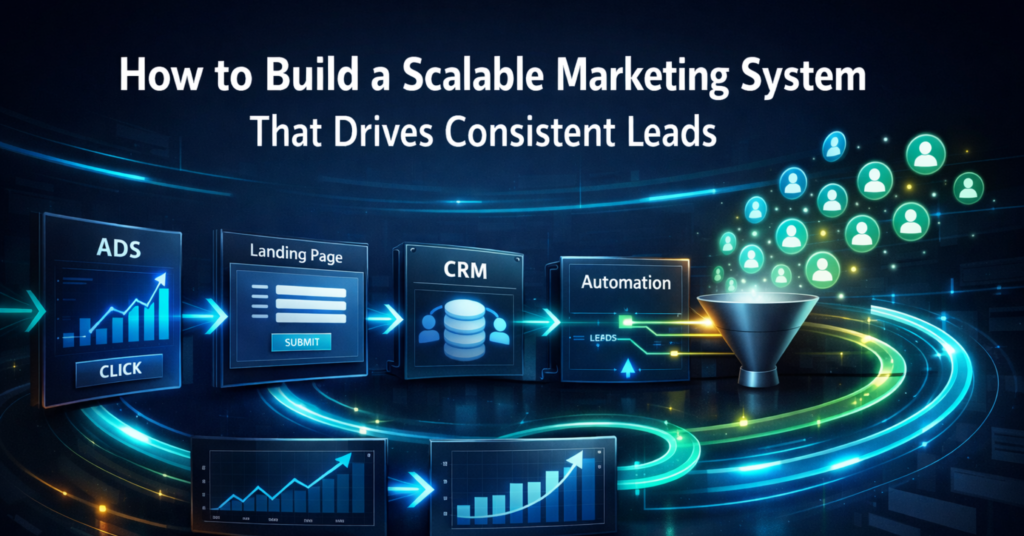
A high-performing system is built on four key layers:
- Traffic Generation
- Lead Capture
- Nurture & Automation
- Conversion Process
Each layer supports the next. If one fails, the entire system weakens.
The Scalable Lead Generation System Framework
This is where structure becomes clear.
| Stage | System Component | Goal |
| Traffic | Paid ads, SEO, LinkedIn | Attract targeted audience |
| Capture | Landing pages, forms | Convert visitors into leads |
| Nurture | Email, retargeting | Build trust automatically |
| Conversion | Calls, offers | Turn leads into clients |
This is the foundation of any effective lead generation system.
Step 1: Build Reliable Traffic Sources
You cannot scale without consistent traffic.
Effective sources include:
- Paid ads (Meta, Google)
- SEO-driven content
- LinkedIn content and outreach
- Partnerships and referrals
A strong lead generation strategy uses multiple channels but focuses on what performs best.
Consistency matters more than variety.
Step 2: Create a Conversion-Focused Funnel
Traffic alone doesn’t generate leads.
You need a clear sales funnel system.
A strong funnel includes:
- A compelling offer
- A focused landing page
- A simple lead capture process
- A clear next step
Removing friction at this stage significantly improves conversions.
Step 3: Automate Lead Nurturing
Most leads don’t convert immediately.
An automated lead generation process ensures no opportunity is lost.
Key automation elements include:
- Email sequences
- Retargeting campaigns
- Follow-up reminders
- Educational content delivery
This builds trust while reducing manual work.
Step 4: Build a Marketing Automation System
A proper marketing automation system connects all parts of your funnel.
It allows you to:
- Track user behavior
- Trigger automated responses
- Segment audiences
- Improve personalization
Automation increases efficiency and makes scaling possible.
Step 5: Optimize the System Continuously
A scalable system is never static.
Ongoing improvements include:
- Testing new offers
- Improving landing pages
- Refining targeting
- Analyzing lead quality
- Adjusting follow-up sequences
Small improvements across the system compound over time.
Signs Your Marketing System Is Not Scalable
You likely don’t have a scalable system if:
- Leads come inconsistently
- You rely heavily on manual outreach
- There is no follow-up automation
- Conversion rates are unpredictable
- Growth depends on constant effort
A proper system removes these bottlenecks.
Scalable Marketing System vs Traditional Marketing
This distinction is critical for long-term growth.
| Traditional Marketing | Scalable Marketing System |
| Manual effort | Automated processes |
| Inconsistent leads | Predictable lead flow |
| One-channel focus | Multi-channel system |
| Short-term campaigns | Long-term system |
| Hard to measure | Data-driven decisions |
This is why businesses shift toward business growth systems instead of isolated campaigns.
How a Scalable System Drives Business Growth
A strong system creates:
- Predictable lead flow
- Better conversion rates
- Lower cost per acquisition
- More efficient use of resources
- Faster scaling opportunities
This is how marketing becomes a growth engine, not just an expense.
Final Takeaway
A scalable marketing system is not built overnight, but once it’s in place, it changes how your business grows.
When you:
- Build a structured lead generation system
- Use a clear sales funnel system
- Implement marketing automation
- Continuously optimize
You move from chasing leads to controlling your growth.
That’s the difference between random success and consistent results.