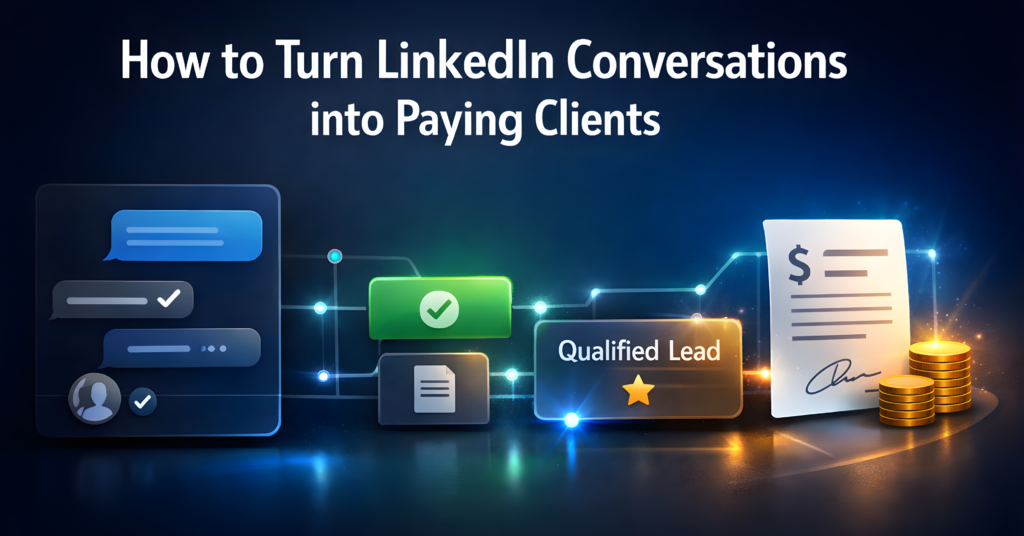
Most people are having LinkedIn conversations.
Very few are converting them into clients.
The problem isn’t LinkedIn.
It’s how those conversations are started, guided, and closed.
This article breaks down how to turn LinkedIn conversations into paying clients by using a clear, ethical, and repeatable system, without sounding salesy or burning relationships.
The Real Reason LinkedIn Conversations Don’t Convert
Most LinkedIn DMs fail because they:
- Start with a pitch instead of context
- Focus on the sender, not the buyer
- Skip trust-building
- Have no conversion path
A conversation without direction is just noise.
LinkedIn client acquisition works when conversations are designed to progress, not impress.
Quick Answer: What Actually Converts LinkedIn Conversations
LinkedIn conversations convert into clients when they:
- Start with relevance, not a pitch
- Establish value before intent
- Diagnose problems before offering solutions
- Progress naturally toward a business outcome
Selling on LinkedIn is not about messaging volume.
It’s about conversation quality and structure.
LinkedIn Conversations Are Not Sales Calls (And That’s the Advantage)
A LinkedIn conversation is not a sales call.
It’s a relationship-building channel.
That’s why:
- Aggressive pitching fails
- Long explanations lose attention
- Generic scripts get ignored
Effective social selling on LinkedIn feels like problem-solving, not selling.
Step 1: Start Conversations the Right Way
Most LinkedIn conversations fail in the first message.
What doesn’t work
- “Hope you’re doing well…”
- Instant service pitches
- Copy-paste templates
- Talking about credentials
What works
- Contextual relevance
- A reason for reaching out
- A light, curiosity-based opener
Good LinkedIn prospecting starts with why this person, why now.
Step 2: Guide the Conversation (Don’t Control It)
The goal is not to dominate the conversation.
It’s to guide it forward.
High-converting LinkedIn conversations:
- Ask thoughtful questions
- Listen more than they talk
- Mirror language and priorities
- Avoid premature solutions
This is the foundation of LinkedIn relationship building.
Step 3: Diagnose Before You Offer
Most people pitch before understanding the problem.
That’s why resistance appears.
Instead, uncover:
- What they’re trying to achieve
- What’s currently not working
- What they’ve already tried
- What success would look like
Only after diagnosis does a solution feel relevant.
This is where LinkedIn conversations with clients begin.
Step 4: Position the Solution Naturally
A solution should feel like a logical next step, not a surprise pitch.
What works
- “Based on what you said…”
- “This is usually where we help…”
- “Would it be useful if…”
This keeps the conversation collaborative, not transactional.
A strong LinkedIn sales strategy never forces the offer.
Step 5: Move from Conversation to Conversion
Conversations convert when there’s a clear transition, not a hard close.
Examples:
- Suggesting a short call to explore further
- Offering a quick audit or walkthrough
- Sharing a relevant case or example
The key is timing, conversion happens after trust, not before.
The LinkedIn Sales Funnel (Conversation to Client)
This is the only place a table adds value, clarity and compression.
| Stage | Goal | What to Focus On |
| Connection | Start dialogue | Relevance |
| Conversation | Build trust | Listening |
| Diagnosis | Identify problems | Questions |
| Positioning | Introduce solution | Context |
| Conversion | Next step | Low friction |
Without a funnel, conversations drift.
With one, they convert.
Common Mistakes That Kill LinkedIn Conversions
- Pitching too early
- Talking too much
- Sounding scripted
- Ignoring buying signals
- Never asking for the next step
Most failed LinkedIn DM strategies don’t fail because of rejection—they fail because of misalignment.
LinkedIn Conversion Strategy: What Actually Matters
High-performing LinkedIn conversion strategies focus on:
- Message relevance
- Conversation flow
- Trust before transaction
- Clear next actions
Tools and automation amplify results, but only after the system works.
Final Takeaway
LinkedIn doesn’t reward the loudest sellers.
It rewards the most relevant and trustworthy communicators.
When you:
- Start conversations with context
- Guide them with intent
- Diagnose before offering
- Transition naturally to action
LinkedIn conversations stop being chats and start becoming clients.