Running ads is easy. Building a funnel that turns clicks into clients is not.
Most businesses don’t have an ad problem.
They have a funnel problem.
If traffic comes in but revenue doesn’t scale. Your ad funnel strategy is broken somewhere between click and conversion.
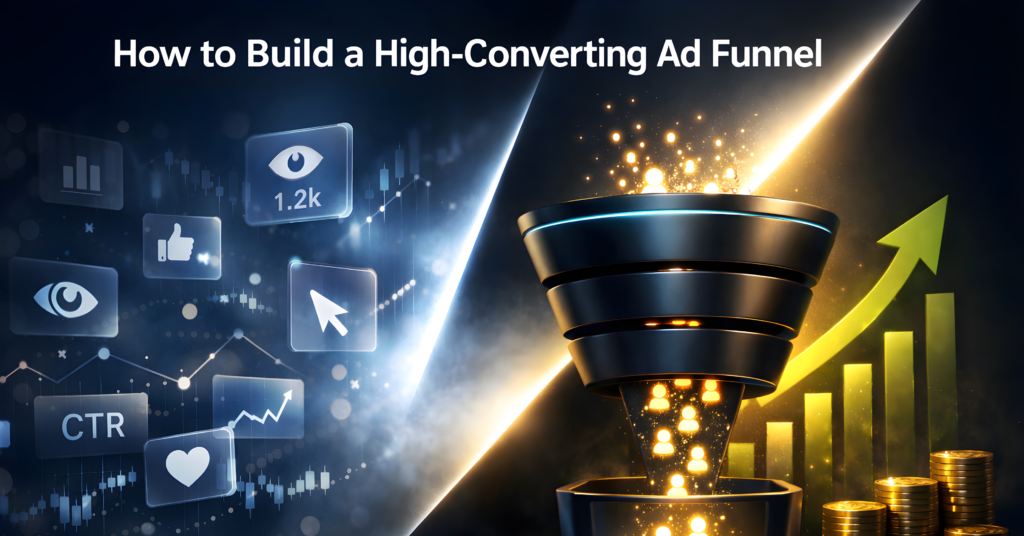
This guide breaks down how to build a high-converting ad funnel that turns paid traffic into predictable customer acquisition.
What an Ad Funnel Strategy Actually Means
An ad funnel strategy is the structured path a prospect follows from:
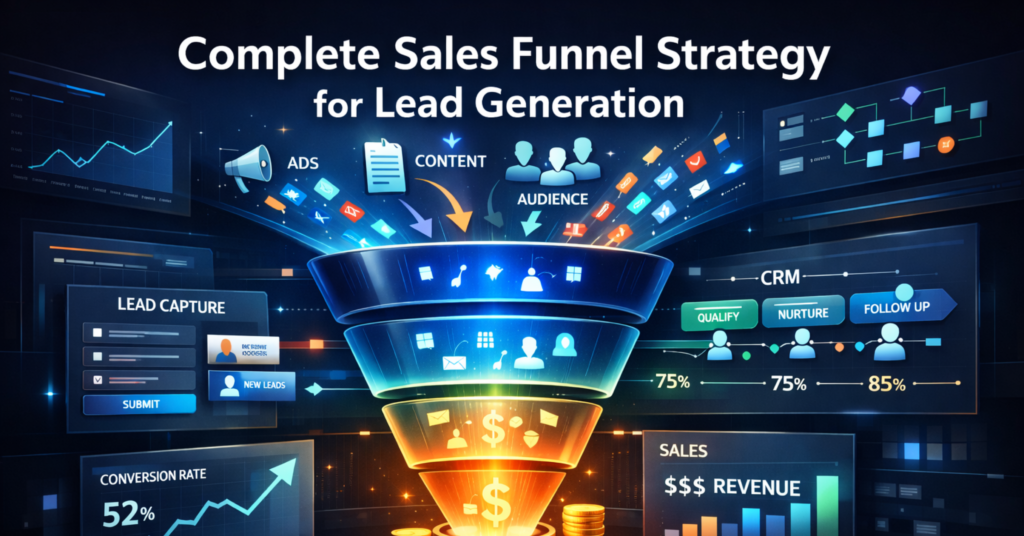
Ad → Landing Page → Trust Building → Offer → Conversion → Follow-Up
Without structure, paid traffic becomes expensive experimentation.
With structure, it becomes a customer acquisition funnel.
The Core Components of a High-Converting Ad Funnel
A profitable paid traffic funnel has four essential layers:
- Traffic
- Pre-Frame
- Conversion Mechanism
- Follow-Up System
Step 1: Define the Offer Before You Launch Ads
Most funnels fail because the offer isn’t clear enough.
Before building pages or ads, define:
- What specific outcome you help achieve
- Who it is for
- Why it’s different
- Why now
High-performing ad funnel strategies start with clarity, not creatives.
If the offer doesn’t convert organically, ads won’t fix it.
Step 2: Align the Paid Traffic Funnel With Intent
Not all traffic is equal.
A strong paid traffic funnel matches the ad message to the landing page promise.
Common mistakes:
- Broad targeting with narrow offers
- Aggressive sales pages for cold traffic
- Sending all traffic to the same page
Cold traffic needs education.
Warm traffic needs proof.
Hot traffic needs simplicity.
Your funnel marketing strategy must reflect that.
Step 3: Build a Landing Page Designed for Conversion
Your landing page is not a website homepage.
It is a decision environment.
High-performing landing page optimization includes:
- Clear headline matching the ad
- One primary outcome
- Social proof
- Risk reduction
- Single CTA
Remove navigation distractions.
Remove competing offers.
Remove friction. Conversion rate optimization begins with focus.
Step 4: Add a Lead Generation Layer (Even for Sales Funnels)
Even if you sell directly, most prospects are not ready immediately.
A strong lead generation funnel captures interest before commitment.
Examples:
- Free audits
- Strategy calls
- Case studies
- Lead magnets
This builds your pipeline and reduces acquisition cost over time.
The Ad to Client Funnel Structure
This is where structure matters most.
| Stage | Goal | What Happens |
| Ad | Capture attention | Problem-focused message |
| Landing Page | Build clarity | Align promise + proof |
| Lead Capture | Secure contact | Form or booking |
| Nurture | Build trust | Email / retargeting |
| Conversion | Close sale | Call or checkout |
Without nurture, most funnels lose 70–90% of potential revenue.
Step 5: Optimize the Marketing Funnel, Not Just the Ad
Most advertisers optimize CTR and CPC.
High-level marketers optimize flow.
Marketing funnel optimization means:
- Improving message match
- Increasing landing page clarity
- Reducing form friction
- Shortening response time
- Strengthening follow-up
Improving one step by 10% compounds across the funnel.
B2B Sales Funnel vs B2C Paid Funnel
If you run a B2B sales funnel, your structure must reflect:
- Longer decision cycles
- Multiple stakeholders
- Higher ticket size
- Trust-first positioning
B2B ad funnel strategy requires:
- More proof
- More qualification
- More follow-up
Trying to rush B2B funnels kills conversions.
Where Most Ad Funnel Strategies Fail
- Scaling traffic before funnel validation
- No clear next step after opt-in
- Weak follow-up system
- No retargeting layer
- Poor conversion rate optimization discipline
The issue is rarely the platform.
It’s almost always the funnel.
How to Know If Your Ad Funnel Is Broken
Signs your funnel needs optimization:
- High click-through rate, low conversions
- Strong leads, weak close rate
- Many form submissions, few buyers
- High cost per acquisition despite strong ads
Each symptom points to a different stage failure.
Final Takeaway
Ads amplify whatever funnel you build.
If the funnel is weak, ads scale losses.
If the funnel is strong, ads scale revenue.
A high-converting ad funnel strategy requires:
- Clear offer
- Intent alignment
- Strong landing page optimization
- Smart lead generation funnel
- Relentless marketing funnel optimization
Build the system first.
Then scale the traffic.