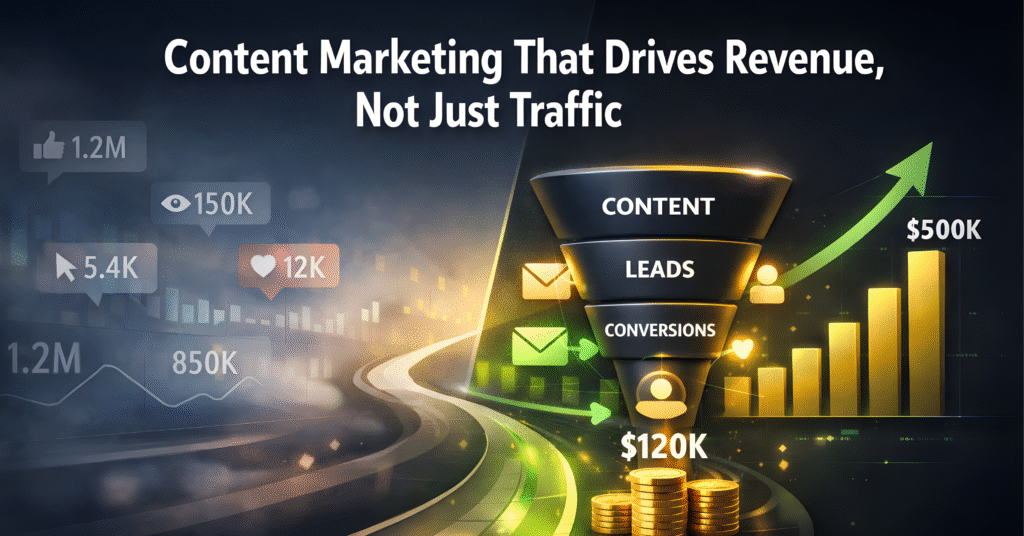
Content marketing has been misunderstood for years.
Most businesses associate it with:
- Traffic growth
- Engagement
- Brand awareness
Very few associate it with revenue and that’s exactly why most content marketing underperforms.
Traffic without intent does not grow a business.
Revenue-driven content marketing does.
This article breaks down how to build a content marketing strategy that drives revenue, not vanity metrics, and how to align content with real business growth.
Quick Answer: How Content Drives Revenue
Content marketing drives revenue when it:
- Targets high-intent demand, not just volume
- Supports the entire buying journey
- Reduces friction before asking for action
- Builds trust at the right moment
- Connects content directly to lead generation and sales
Content that isn’t designed for conversion rarely produces ROI.
Why Most Content Marketing Fails to Produce ROI
The most common mistake is optimizing content for traffic instead of outcomes.
Where it goes wrong
- Topics chosen without commercial intent
- High-volume keywords with low buying relevance
- Content disconnected from offers
- Success measured by views instead of pipeline
The result: content that looks successful in analytics but fails to impact revenue.
Content Marketing Strategy Starts With Intent, Not Ideas
A strong content marketing strategy begins with understanding why someone is searching.
Every search represents:
- A problem
- A level of awareness
- A readiness to act
If content does not match that stage, it won’t convert, regardless of rankings.
This is the foundation of content marketing optimization.
The Content Marketing Funnel (Where Revenue Is Actually Created)
Content that converts works as a system, not as isolated blog posts.
| Funnel Stage | Content Role | Revenue Impact |
| Awareness | Frame the problem | Attract qualified traffic |
| Consideration | Clarify options | Build preference and trust |
| Decision | Reduce risk | Generate leads or sales |
Most businesses publish awareness content only—and expect revenue to appear later. It doesn’t.
Traffic-Focused Content vs Conversion-Focused Content
This distinction determines whether content supports growth or just visibility.
| Element | Traffic-Focused Content | Conversion-Focused Content |
| Goal | Rankings | Revenue |
| Keyword choice | High volume | High intent |
| Depth | Broad | Decision-oriented |
| CTA | Generic or missing | Contextual and timed |
| Measurement | Sessions | Leads and sales |
Content that converts is written to support decisions, not just rankings.
Content Marketing for Lead Generation (Where ROI Becomes Visible)
Revenue doesn’t come from content itself—it comes from what content enables next.
Effective Content-driven growth for lead generation includes:
- Clear next steps
- Intent-matched CTAs
- Logical internal paths to offers
- Trust-building before conversion
Asking for a sale too early suppresses both conversions and engagement.
B2B Content Marketing Requires a Different Lens
In B2B, buying decisions are:
- Slower
- More complex
- Risk-sensitive
Effective B2B Content-driven growth focuses on:
- Use cases and outcomes
- Risk reduction
- Decision clarity
- Business impact
Educational content that doesn’t move buyers closer to a decision is incomplete.
Content Marketing ROI: What Actually Matters
Most teams track metrics that feel good but don’t drive growth.
Low-value metrics
- Page views
- Likes and shares
- Raw time on page
Revenue-aligned metrics
- Lead quality
- Conversion rate by content type
- Assisted conversions
- Pipeline influence
If content isn’t connected to business growth, ROI will always look unclear.
Content-driven growth Optimization for Revenue Growth
Optimization is not about rewriting everything.
It’s about aligning what already exists.
High-impact optimization actions:
- Update CTAs to match intent
- Improve internal linking toward revenue pages
- Clarify positioning and outcomes
- Remove or repurpose low-performing content
Most ROI gains come from optimization, not volume.
Common Myths About Content Marketing
- ❌ “Content is just for awareness”
- ❌ “More content equals more growth”
- ❌ “SEO content doesn’t convert”
- ❌ “Revenue comes after traffic”
Revenue-focused content marketing is intentional by design.
Final Takeaway
Content marketing is not about publishing more.
It’s about publishing with purpose.
When content is aligned with:
- Buyer intent
- Funnel stages
- Clear conversion paths
It stops being a cost center and becomes a revenue engine.