
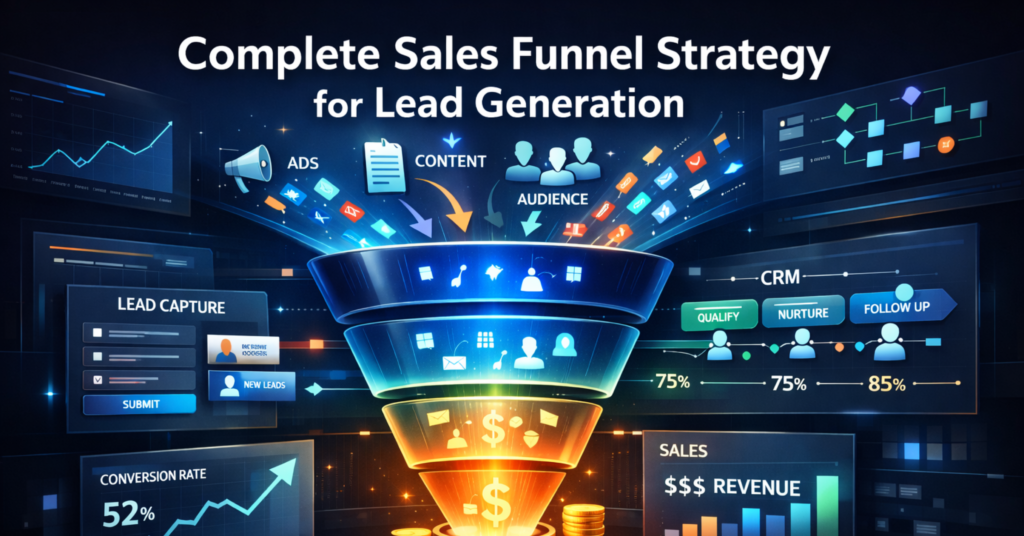
Many businesses try to generate leads before building the right funnel.
They run ads, publish content, and send traffic to landing pages, but leads either don’t convert or remain inconsistent.
The problem is rarely traffic.
It’s the sales funnel structure behind the traffic.
A well-designed sales funnel for lead generation guides prospects from awareness to trust to action in a structured way. When this system works, lead generation becomes predictable instead of random.
What a Sales Funnel for Lead Generation Really Means
A sales funnel is the path potential customers follow from their first interaction with your brand to becoming a lead and eventually a paying client.
A strong lead generation funnel does three things well:
- Attracts the right audience
- Builds credibility quickly
- Converts interest into action
Without this structure, even high traffic volumes fail to produce results.
The Core Stages of a Lead Generation Funnel
Every effective funnel follows a similar progression.
| Funnel Stage | Purpose | Outcome |
| Awareness | Capture attention | Attract relevant prospects |
| Interest | Educate and position value | Build trust |
| Consideration | Present solutions | Generate leads |
| Conversion | Turn leads into customers | Revenue |
When each stage is optimized, the entire conversion funnel strategy becomes more efficient.
Step 1: Attract the Right Audience
The first step in any marketing funnel strategy is attracting people who actually have the problem you solve.
Traffic sources may include:
- Paid ads
- Search engine traffic
- LinkedIn content
- Industry partnerships
- Referrals
The goal is not maximum traffic.
It is relevant traffic.
Quality audiences dramatically improve funnel performance.
Step 2: Capture Leads With a Clear Offer
Once traffic arrives, the next step is turning visitors into leads.
A high-performing lead generation funnel typically offers something valuable in exchange for contact information.
Examples include:
- Free strategy calls
- Industry reports
- Audit sessions
- Case studies
- Educational resources
The offer must solve a specific problem your audience cares about.
Step 3: Use a Paid Ads Funnel to Accelerate Growth
Organic traffic builds authority over time, but paid ads funnels can accelerate lead generation.
Paid traffic platforms often include:
- Meta Ads
- Google Ads
- LinkedIn Ads
These channels allow businesses to reach targeted audiences quickly and test funnel performance faster.
However, ads amplify whatever funnel exists.
If the funnel is weak, ads scale inefficiency.
Step 4: Build Trust Through Follow-Up
Most leads do not convert immediately.
A successful funnel nurtures prospects through:
- Email sequences
- Retargeting ads
- Educational content
- Case studies
This step strengthens credibility and improves conversion rates.
Trust-building is one of the most overlooked parts of sales funnel optimization.
Step 5: Optimize the Conversion Funnel Strategy
Even strong funnels require ongoing optimization.
Important improvement areas include:
- Landing page clarity
- Offer positioning
- Form length and friction
- Ad message alignment
- Lead qualification
Small improvements across the funnel compound and significantly improve lead generation results.
Example Structure of a Paid Lead Generation Funnel
This simplified framework shows how many modern funnels operate.
| Funnel Step | Key Action |
| Ad | Target the right audience |
| Landing Page | Present a clear offer |
| Lead Form | Capture contact details |
| Follow-Up | Nurture with email or retargeting |
| Sales Interaction | Convert qualified leads |
When executed correctly, this paid ads funnel becomes a scalable system for customer acquisition.
Common Mistakes in Lead Generation Funnels
Several mistakes frequently weaken funnel performance:
- Sending traffic to generic pages
- Offering unclear value propositions
- Asking for too much information in forms
- Ignoring follow-up sequences
- Scaling ads before validating the funnel
Correcting these issues often improves results faster than increasing ad budgets.
Sales Funnel Optimization Best Practices
Businesses that generate consistent leads focus on improving their funnel continuously.
Effective optimization includes:
- Testing multiple offers
- Improving landing page messaging
- Analyzing lead quality, not just quantity
- Refining targeting and traffic sources
- Strengthening follow-up communication
A strong conversion funnel strategy evolves with audience behavior and market conditions.
Final Takeaway
A successful sales funnel for lead generation is not just a marketing tactic, it’s a structured system for customer acquisition.
When businesses align their:
- Marketing funnel strategy
- Lead generation offers
- Paid ads funnel
- Follow-up process
- Conversion funnel strategy
Lead generation becomes predictable and scalable.
Instead of hoping for leads, you build a system designed to produce them consistently.